Fractionova

Automotive Performance: Where Should a Specialist Capability Compete Next?

An illustrative Opportunity Intelligence assessment

A specialist engineering capability can support several credible growth directions. Choosing where to commit requires a connected assessment of customer demand, technical fit, market access, production economics and control over the resulting business.

This example illustrates how Fractionova’s AI-native Opportunity Intelligence could inform that choice, including the potential for local manufacturing in India.

This is a hypothetical scenario. The business, counterparties, evidence and recommendations are illustrative. They do not describe a client engagement, verified market opportunity or achieved outcome.

The business and the decision

Consider a manufacturer of adjustable performance dampers with an established but limited motorsport customer base.

Its capabilities include mechanical design, application-specific calibration, low-volume manufacturing and technical support. Management wants to expand, with sufficient engineering and commercial capacity to pursue one substantial new programme alongside its existing business.

Three directions appear credible:

  • Deepen its motorsport position, working with additional teams, preparation businesses and specialist distributors.
  • Supply specialist vehicle manufacturers, developing products for defined vehicle programmes.
  • Enter the performance aftermarket, building a proposition around selected vehicle applications and an appropriate installation and distribution network.

India is also under consideration as a potential customer market and production location.

The decision is where to concentrate capability, through which commercial relationships, and with what level of investment and technical commitment.

Establish the commercial thesis

The starting point is to test how the manufacturer’s existing capabilities translate into value for each prospective customer.

A motorsport preparation business may prioritise calibration support, responsiveness and repeatable performance within a specific application. A specialist vehicle manufacturer may require development work, validation, documentation and sustained production support. An aftermarket proposition may depend on application coverage, installation quality, channel economics and product support.

Each route introduces a different combination of obligations and opportunity.

Fractionova’s investigation would develop a commercial thesis for each route, connecting the customer requirement with the manufacturer’s ability to serve it profitably and retain a defensible position.

Compare the routes before committing

Potential route Central commercial question Dependencies to investigate
Motorsport expansion Where does the existing capability offer a compelling application-specific advantage? Technical credibility, access to teams and preparation businesses, calibration requirements, support intensity and repeat demand.
Specialist vehicle programmes Which programme could justify the development and production commitment? Programme credibility, engineering scope, validation, development funding, production volumes and purchasing authority.
Performance aftermarket Which applications and channel structure could support a commercially viable launch? Product coverage, installation capability, distributor commitments, warranty exposure, inventory and customer access.

These are questions to investigate. A plausible application becomes an investable opportunity only as its critical assumptions acquire supporting evidence.

How Fractionova would investigate

Technical and application fit

AI-assisted investigation would connect product capabilities with application requirements, identifying where the existing platform offers a credible starting point and where adaptation could introduce significant cost or delay.

Technical assessment would examine calibration demands, operating conditions, installation requirements and the evidence needed to support performance claims.

Specialist judgement would challenge the resulting conclusions and identify what requires direct engineering validation.

Customer access and buying structure

The assessment would distinguish organisations expressing interest from those able to specify, evaluate, purchase or influence adoption.

AI-driven relationship analysis would help identify the relevant commercial structure: the end customer, technical evaluator, preparation business, distributor or vehicle programme owner.

The resulting engagement priorities would reflect decision authority, application relevance and the prospect of a viable commercial relationship.

Economics and obligations

Each route would be assessed against the commitments it creates.

Development effort, tooling, inventory, technical support, payment timing and warranty responsibilities would be considered alongside prospective revenue and margin.

An attractive sales prospect can carry an unattractive allocation of cost, risk or dependency.

The assessment would make those obligations visible before resources are committed.

Counterparties and commercial control

Partner investigation would examine capability, customer access, commercial alignment and the proposed allocation of responsibilities.

A distributor requesting exclusivity would require a different assessment from a preparation business purchasing for identified applications. A vehicle manufacturer seeking supplier-funded development would introduce a different investment decision again.

The investigation would establish what each relationship contributes, what it requires and which commitments need evidence before progression.

Account for the changing trade environment

The preferred route could change as market-access conditions change.

In this scenario, a prospective customer might favour local assembly and support. A distributor might offer market access in return for territorial exclusivity. A potential manufacturing partner might propose a structure that changes the economics of serving the market.

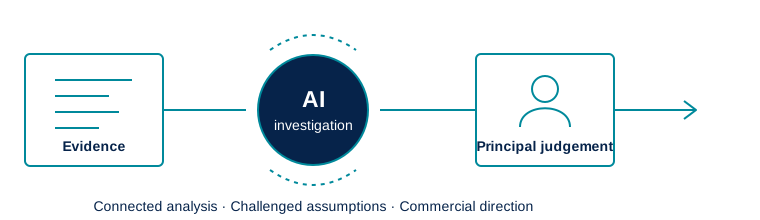
Fractionova’s AI engine would connect relevant trade, policy and geopolitical signals with these commercial options, reassessing where access expands, where constraints emerge and which assumptions need further investigation.

Any proposed advantage from a tariff treatment, trade agreement or localisation measure would require verification against the actual product, origin and operating arrangement.

Customer preference, commercial convenience and formal market-access requirements would be assessed separately.

Could local production strengthen the automotive opportunity?

Assume the manufacturer is also evaluating India as a potential market and production location.

Alongside the choice of customer application, the assessment would examine whether to supply finished products from its existing facilities, establish local assembly and calibration, or develop manufacturing through a qualified partner.

Potential structures could include contract manufacturing, an equity joint venture or a technology-licensing arrangement with agreed commercial consideration, including royalties.

The strategic question is which capabilities to establish locally, which to retain and how the arrangement would strengthen the manufacturer’s commercial position.

Fractionova’s AI-driven investigation would connect application demand with production requirements, partner capability, investment exposure and the economics of each arrangement. Principal-led assessment would examine how localisation affects technical control, customer relationships and the value retained by the technology owner.

The investigation would address:

  • Which products and applications provide a credible basis for local production?
  • What demand evidence justifies tooling, training and production capacity?
  • Which manufacturing, calibration and quality-assurance capabilities must a partner demonstrate?
  • What technical knowledge would need to be shared, and where should control remain?
  • How would ownership, development funding, licence payments or royalties affect the commercial case?
  • Could the arrangement support additional markets, and what would need to be established before assuming that potential?

Local production would become a qualified strategic option when demand, capability, investment and commercial alignment support it.


What the illustrative evidence might reveal

Assume the investigation produces the following findings:

Route Illustrative finding Decision implication
Motorsport expansion Two preparation businesses express interest in applications close to the manufacturer’s existing experience. Orders remain unconfirmed. A bounded qualification programme could test customer commitment and support requirements with relatively limited product adaptation.
Specialist vehicle programme A prospective manufacturer identifies a potential programme, but requirements and timing remain unsettled. Supplier-funded development is expected. Preserve the opportunity while establishing programme credibility, development scope and investment responsibilities.
Performance aftermarket A distributor seeks a broad product range and regional exclusivity without minimum purchase commitments or an agreed support allocation. The proposed arrangement requires substantial qualification and commercial restructuring before commitment.
Local production in India No manufacturing partner has yet been qualified, and committed production volumes remain unestablished. Investigate localisation alongside customer qualification, with investment decisions tied to demand, capability and control.

These assumptions support a provisional direction. They do not establish a completed commercial case.

The resulting commercial direction

Prioritise a bounded motorsport qualification programme

Focus the immediate effort on selected applications with the two preparation businesses.

Establish the technical requirement, evaluation process, support expectations and purchasing pathway. Define what evidence would justify moving from evaluation to repeat supply.

This route provides a focused way to test commercial relevance while drawing on capabilities the manufacturer already possesses.

Preserve the specialist vehicle opportunity through milestones

Continue engagement around the prospective vehicle programme, with explicit milestones for requirements, timing, development funding and purchasing commitment.

Further engineering expenditure would follow an increasingly credible programme case.

Reframe the aftermarket proposition

Explore a narrower initial application range, defined launch responsibilities and measurable distributor commitments.

The assessment would test whether a revised arrangement can justify inventory and support investment while preserving appropriate commercial flexibility.

Evaluate localisation against defined investment milestones

Develop the India production thesis alongside application and customer qualification. Compare supply from existing facilities with local assembly, contract manufacturing, a joint venture and technology licensing.

Under this illustrative scenario, no qualified manufacturing partner or committed production volume has yet been established. A manufacturing commitment would therefore follow evidence of sufficient demand, repeatable quality and an acceptable allocation of investment and technical control.

A credible local partner bringing production capability, customer access and a balanced investment proposal could change the preferred sequence.

What would change the recommendation?

The assessment would specify the developments that could alter the priorities.

A funded vehicle programme with credible volumes and agreed engineering responsibilities could justify earlier commitment. Weak purchasing intent or disproportionate support demands could reduce the attractiveness of the motorsport route.

A distributor willing to support a focused launch with meaningful commitments could strengthen the aftermarket case. A qualified manufacturing partner with customer access and an acceptable investment proposal could accelerate localisation.

The recommendation remains connected to the evidence that supports it and the conditions that could change it.

What the business would receive

The assessment would produce a decision package covering:

  • A qualified commercial thesis for the priority applications and customer groups.
  • A comparison of strategic options, including their economics, dependencies and unresolved assumptions.
  • A counterparty qualification and engagement plan, focused on decision authority and commercial fit.
  • A localisation assessment, connecting production structures with demand, investment and technology control.
  • A proposed sequence of commitments, with milestones for engineering, customer development and capital.
  • A reassessment framework, identifying developments that would strengthen, weaken or redirect the opportunity.

The value lies in a coherent basis for allocating capability and investment, with the reasoning and outstanding uncertainties made explicit.

Apply Opportunity Intelligence to your next decision

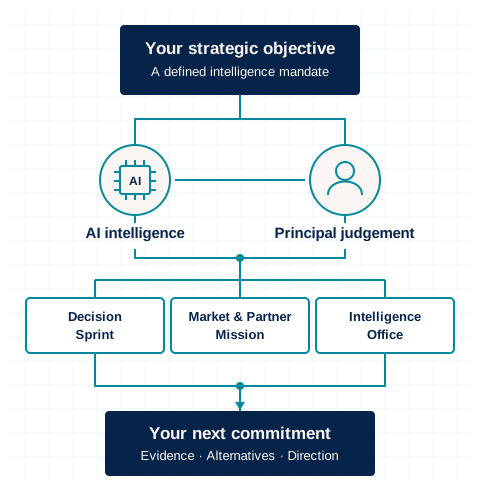
A Decision Sprint can assess a defined choice of application, market or investment direction.

A Market & Partner Mission can develop the market-entry thesis, qualify counterparties and prepare the basis for engagement.

A Fractionova Intelligence Office can maintain the business context and reassess the opportunity as customer, technology and trade conditions evolve.

Start a Decision

Back to top