Fractionova

Data-Centre Cooling: Which Route to Market Creates a Defensible Position?

An illustrative Opportunity Intelligence assessment

For a specialist cooling supplier, a prospective market presents several connected decisions: which projects to pursue, how to reach the customer, who will deliver and support the installation, and whether local production would strengthen the commercial model.

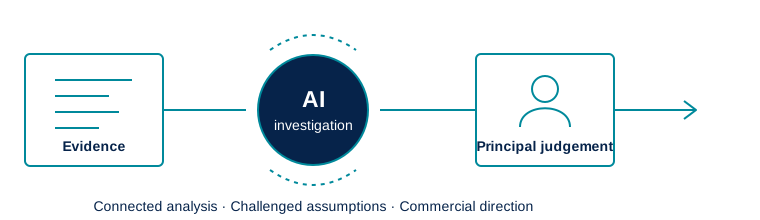
This example illustrates how Fractionova’s AI-native Opportunity Intelligence could assess those decisions together.

This is a hypothetical scenario. The business, counterparties, evidence and recommendations are illustrative. They do not describe a client engagement, verified market opportunity or achieved outcome.

The business and the decision

Consider a supplier of modular liquid-cooling equipment with documented deployments in other markets.

Its capabilities include equipment design, manufacturing, application engineering and commissioning support. It is evaluating entry into India but has no established local service network.

Management has the capacity to support one initial deployment and wants that investment to establish a credible foundation for further business.

Three routes are under consideration:

  • Direct engagement with data-centre operators, retaining a close technical and commercial customer relationship.
  • An integrator-led entry, contributing equipment and expertise within a broader project-delivery proposition.
  • A local delivery partnership, combining market access, installation and continuing support through a partner.

Local assembly or manufacturing could also form part of the entry model.

The decision is which combination of project, commercial access and delivery capability can support a viable first deployment and a defensible position beyond it.

Establish the commercial thesis

An announced project, an interested intermediary and a technically suitable application each provide a different starting point.

The commercial thesis must connect the equipment to a sufficiently defined requirement, an accessible procurement process and a credible delivery arrangement.

The assessment would investigate who influences the specification, who selects the supplier, how the equipment fits the proposed installation and who carries responsibility for commissioning and continuing support.

It would also examine whether the first deployment could establish reusable capabilities and relationships, or leave the supplier dependent on an arrangement that limits future participation.

Compare the entry models

Entry model Potential commercial position Dependencies to investigate
Direct operator engagement A direct relationship with the customer and visibility into technical requirements and future demand. Procurement access, qualification, local installation, service coverage and the supplier’s capacity to coordinate delivery.
Integrator-led entry Participation in a defined project through an organisation responsible for a broader delivery scope. Integrator influence, technical interfaces, responsibility allocation, commercial terms and continuing customer access.
Local delivery partnership A combined proposition covering market access, installation and support. Demonstrated partner capability, customer relationships, investment commitments, exclusivity, inventory and service responsibilities.

The preferred model would depend on the requirements of an accessible project and the capability of the organisations involved.

How Fractionova would investigate

Establish whether the project is actionable

AI-driven investigation would connect project signals with evidence of procurement readiness, technical definition and decision authority.

The assessment would seek to establish the relevant customer requirement, purchasing pathway, evaluation process and timing.

This would help prioritise projects where further technical and commercial effort has a credible purpose.

Examine technical and operational fit

The investigation would assess the proposed equipment against the project’s stated requirements and interfaces.

Application engineering and specialist review would address the installation configuration, commissioning requirements, testing and acceptance process, and continuing support obligations.

Unresolved technical assumptions would become explicit qualification tasks.

Qualify the delivery network

A viable entry model would require evidence of the capabilities needed to deliver it.

Partner assessment would examine relevant experience, available personnel, training requirements, installation capability, service coverage and access to spares.

AI-assisted counterparty research would support the investigation, with direct qualification and technical review used to test material claims.

A partner’s stated reach becomes commercially useful when it is supported by the capability and commitment the project requires.

Assess the allocation of responsibility and value

The commercial analysis would connect equipment revenue with the costs and obligations needed to deliver it.

Training, application engineering, commissioning, inventory, working capital and continuing support would be considered alongside payment terms and contractual responsibilities.

The assessment would examine how the entry structure affects margin, customer access, technical feedback and the supplier’s ability to participate in subsequent projects.

Integrate trade and geostrategic conditions

Assume that a prospective customer requires local technical support and expresses a preference for local participation.

Those conditions could affect the entry model, the choice of partner and the economics of the first deployment.

Fractionova’s AI engine would connect relevant policy, trade and geopolitical developments with the proposed operating structure. Changes affecting equipment supply, market access or localisation would inform the comparison of options.

The assessment would distinguish a customer preference from a procurement requirement or a verified policy benefit. Any potential advantage would be examined against the actual equipment, supply route and commercial arrangement.

The opportunity scope would expand or narrow as the supporting conditions change.

Could local manufacturing improve the market-entry model?

Assume India is also under consideration as a location for assembly or manufacture serving the proposed cooling opportunity.

The assessment would examine which elements of the offering could be produced or assembled locally, which require specialist supply, and how the resulting configuration affects cost, lead time, quality, commissioning and continuing support.

Potential structures could include a manufacturing contract, an equity joint venture or a technology-transfer and licensing arrangement with defined rights and commercial consideration.

Localisation introduces a connected investment and technology-control decision.

Fractionova’s AI engine would compare the proposed configurations against project demand, supplier capability and delivery requirements. The analysis would test whether the expected commercial benefit remains after accounting for qualification, tooling, training, working capital and continuing technical support.

Key questions would include:

  • Is the project pipeline sufficiently credible to support the proposed capacity?
  • Which assemblies or production activities are suitable for local execution?
  • What testing and quality controls must be demonstrated?
  • Who funds production development and bears the consequences of delayed orders?
  • How would technical changes, product support and performance responsibilities be managed?
  • What access to designs, processes or other know-how is necessary?
  • How would the technology owner retain value through equipment supply, equity participation, licence fees or royalties?

Customer interest in local participation would be examined separately from any verified procurement requirement or policy benefit. The investment case would depend on the actual configuration and evidence.

What the illustrative evidence might reveal

Assume the investigation produces the following findings:

Route Illustrative finding Decision implication
Direct operator engagement An operator is willing to examine the equipment but requires a credible local installation and service arrangement. No purchase commitment exists. Continue technical qualification while establishing how the delivery requirement could be met.
Integrator-led entry An integrator has a defined role in a prospective project and is willing to develop a joint submission. Training and acceptance responsibilities remain unresolved. Investigate a bounded first deployment, subject to technical, commercial and delivery qualification.
Broader local partnership A prospective partner requests exclusivity and supplier-funded inventory without demonstrated delivery capability or a customer commitment. Require stronger evidence and a more balanced allocation of commitments before progressing.
Local manufacturing Production volumes and local manufacturing capability remain unverified. Compare localisation options against demand, qualification costs, investment exposure and technology control.

These findings would favour further qualification of the integrator route under the assumptions of this example.

The resulting commercial direction

Develop a defined first deployment through the integrator

Concentrate initial effort on establishing whether the identified project can support a technically and commercially viable first deployment.

Confirm the integrator’s role, the customer’s requirements and the responsibilities for installation, commissioning, acceptance and support.

Further investment would follow progress against those qualification milestones.

Preserve technical visibility and customer feedback

Structure the relationship so that the supplier can participate appropriately in technical discussions, understand application performance and receive the information needed for continuing support.

Those connections would also inform future product and market decisions.

Continue direct operator qualification

Maintain the direct opportunity while assessing the local delivery capability it would require.

A sufficiently credible customer commitment, combined with an acceptable service arrangement, could change the preferred entry model.

Make the broader partnership conditional on evidence

Test the prospective partner’s delivery capability, customer access and willingness to commit resources.

Exclusivity and inventory commitments would be assessed against demonstrated contribution, defined responsibilities and a supported commercial case.

Establish a staged localisation option

Use qualification of the first deployment to investigate the scope for local assembly or manufacture. Compare the investment and delivery implications before selecting a production partner or commercial structure.

Under this illustrative scenario, production volumes and local manufacturing capability remain unverified. A broader commitment would follow a supported demand case, demonstrated quality capability and agreed responsibilities for technology use, investment and support.

A customer-backed programme or a qualified partner willing to share investment on acceptable terms could justify bringing localisation forward.

Define the milestones for commitment

The assessment would establish the evidence needed before each material commitment.

Those milestones would cover:

  • Project and purchasing authority: a sufficiently defined requirement and a credible route to selection.
  • Technical qualification: agreed interfaces, evaluation requirements and acceptance responsibilities.
  • Delivery capability: a supported plan for installation, commissioning, training and continuing service.
  • Commercial viability: an acceptable allocation of cost, working capital, payment exposure and support obligations.
  • Localisation readiness: sufficient demand and production capability to justify the proposed investment and technology access.
  • Expansion potential: evidence that the first deployment could support further commercially relevant opportunities.

Each milestone would link expenditure and commitment to a clearer understanding of the opportunity.

What would change the recommendation?

A direct operator commitment supported by a credible installation and service arrangement could strengthen the direct route.

Limited integrator influence, unresolved technical responsibilities or unattractive commercial terms could weaken the integrator-led proposition.

A local partner demonstrating delivery capability, customer access and a balanced investment proposal could justify a broader relationship. A customer-backed production programme could bring local manufacturing forward.

Changes in project timing, trade conditions or the supply configuration could also alter the economics and sequence.

The assessment would identify these decision triggers so that management can recognise when the preferred direction needs to change.

What the business would receive

The assessment would produce a decision package covering:

  • A qualified project and market-entry thesis, connected to accessible demand.
  • A comparison of entry models, including commercial position, obligations and dependencies.
  • A counterparty qualification plan, focused on customer access and delivery capability.
  • A responsibility framework for technical evaluation, installation, acceptance and continuing support.
  • A localisation assessment, comparing production options, investment requirements and technology-control implications.
  • A sequence of commitments and reassessment triggers, supporting disciplined progression from investigation to deployment.

The result is a coherent basis for selecting where to enter, how to participate and what must be established before increasing commitment.

Apply Opportunity Intelligence to your next decision

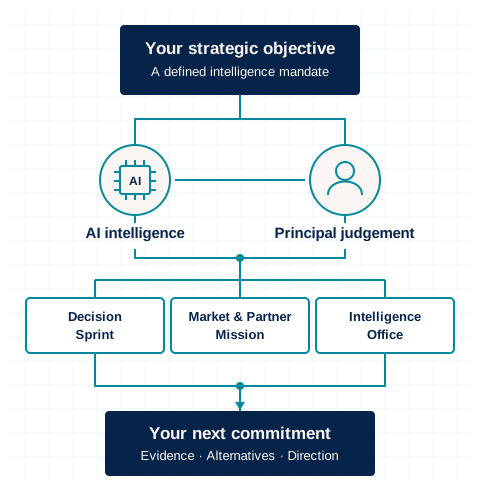
A Decision Sprint can assess the choice of market-entry model or a specific investment decision.

A Market & Partner Mission can investigate accessible projects, qualify delivery and manufacturing partners, and prepare the basis for engagement.

A Fractionova Intelligence Office can retain the agreed business context and reassess the opportunity as projects, counterparties and operating conditions evolve.

Start a Decision

Back to top