

Capability and delivery
Assess the technical, operational and commercial capabilities relevant to the proposed role. Identify which claims have supporting evidence and which require direct qualification.

Market entry commits more than commercial resources. It establishes relationships, dependencies and obligations that shape a business’s position for years.
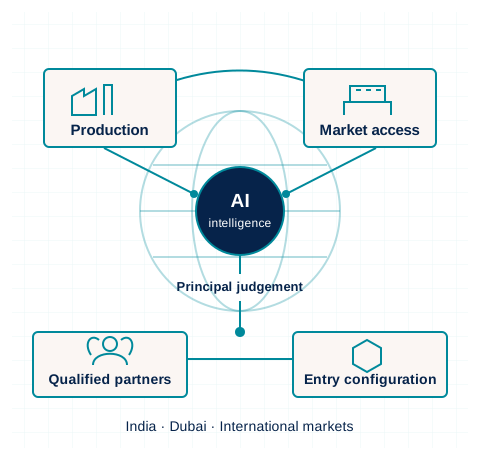
Fractionova brings AI-native Opportunity Intelligence to these consequential choices. Its intelligence engine connects market signals, customer requirements, industrial capabilities, counterparty evidence and geostrategic conditions to develop a commercially grounded direction.
An India–Dubai perspective informs this international outlook: evaluating India as a customer market and production location, Dubai as a potential base for trade and regional expansion, and commercial configurations connecting both with other markets.
For leadership evaluating a new geography, application, supply relationship or manufacturing partnership, the objective is precise: identify an accessible opportunity, establish the conditions for participation and determine which commitments the evidence supports.

An expanding market can accommodate several business models, each with different economics and requirements.
The relevant opportunity depends on how your technology, capabilities, capital and commercial objectives intersect with a specific customer need. It also depends on the route available to reach that customer and the obligations attached to serving them.
Fractionova develops that connection into a market-entry thesis.
AI-driven investigation examines demand, application fit, competitive alternatives, purchasing structures and barriers to participation. Principal-led commercial judgement shapes the investigation and challenges the implications throughout.
The assessment establishes where your business has a credible basis to compete, what must be demonstrated and which assumptions could materially change the investment case.
Market and application selectionWhich geography, customer segment or application deserves priority? Where does the business possess a relevant advantage?
 Route to market
Should entry proceed through direct sales, distribution, an integrator, licensing or a local operating relationship?
 Regional commercial configuration
Where should customer relationships, inventory, distribution and support be located? Would a Dubai-based operation or partner strengthen access to the intended markets?
 Partner and counterparty selection
Which organisations possess the capability, authority, access and alignment the opportunity requires?
 Supply and manufacturing strategy
Which sourcing, assembly or production configuration best supports quality, resilience, economics and customer requirements?
 Localisation and technology participation
Could contract manufacturing, a joint venture or technology licensing strengthen the commercial position?
 Investment sequencing
What should be committed now, what should remain conditional and what evidence justifies progression?
These decisions are assessed together. A change in partner structure can alter the economics of entry. A localisation requirement can reshape the supply model. A credible customer commitment can change the appropriate investment sequence.
Fractionova’s Artificial Intelligence infrastructure supports coordinated investigation across markets, technologies, organisations and operating conditions.
AI agents and analytical workflows connect evidence across these dimensions, examine competing explanations and refine the opportunity against the client’s capabilities, objectives and constraints.
A prospective market is evaluated in relation to the business seeking to enter it. A potential partner is assessed against the role it would need to perform. An apparent advantage is tested against the conditions required to realise it.
The opportunity space expands or narrows as the evidence develops.
Commercial expertise remains integral to framing the questions, challenging assumptions, interpreting conflicting evidence and determining the significance of the findings.
This combination supports a recommendation with an explicit rationale: why a direction merits attention, what its viability depends on and what could change the conclusion.
The value of a counterparty depends on its contribution to the proposed commercial model.
A distributor must offer relevant customer access and the capacity to support the product. An integrator must have a credible role in the project. A manufacturing partner must demonstrate the required production and quality capabilities. A prospective customer must possess a sufficiently defined requirement and a credible purchasing pathway.
For a Dubai-based trading or distribution relationship, qualification extends to the destination markets: which customers the partner actually serves, how transactions and delivery are organised, and who supports the product after sale.
Fractionova’s counterparty intelligence examines these distinctions.
Assess the technical, operational and commercial capabilities relevant to the proposed role. Identify which claims have supporting evidence and which require direct qualification.
Establish how the organisation connects to the intended customer or project, who influences the decision and where purchasing or specification authority resides.

Examine the proposed allocation of investment, margin, inventory, support and customer ownership. Assess whether the parties’ incentives support the intended relationship.

Identify concentration risks, exclusivity implications, reliance on key individuals and the consequences of sharing technical knowledge or market access.

Determine what should be clarified before contact, what can be tested through an initial discussion and what requires deeper technical, financial or legal diligence.
A prioritised counterparty assessment explains why an organisation merits engagement, the role it could fulfil and the conditions that remain unresolved.
A cross-border opportunity can involve several locations performing different commercial roles.
The customer market, manufacturing location, contracting relationship, inventory position and service capability may each require a separate choice. Their combined economics and dependencies determine whether the configuration works.
Fractionova’s India–Dubai perspective brings these choices into a connected assessment.

For an international business, the investigation can connect customer demand with distribution, technical collaboration, local assembly or manufacturing.
AI-driven analysis examines which applications and customer groups justify attention, which capabilities need to be established locally and which partner structures could support the intended position.
The resulting direction may combine imported technology, local production and application-specific customer development, with commitments linked to demonstrated demand and capability.

For a business considering Dubai as a regional commercial base, the assessment examines how that location would contribute to the proposed route to market.
Options may include a trading relationship, specialist distributor, regional sales operation, inventory arrangement or service partnership.
The investigation connects each option with the markets it is intended to serve. It examines customer access, partner reach, delivery responsibilities, working capital and the implications for margin and commercial control.
A Dubai-based relationship earns its place in the strategy through the access, capability and economics it contributes.
An India–Dubai configuration could connect manufacturing or sourcing in India with commercial coordination and distribution through Dubai into selected markets.
Other arrangements may connect an international technology owner with an Indian production partner and a Dubai-based commercial partner.
Fractionova’s AI engine evaluates these configurations against the client’s objectives and the requirements of the destination markets. The assessment compares direct supply with intermediary structures and examines where each activity should sit.
The recommendation addresses a connected question: where should the business produce, contract, hold inventory and serve customers to establish the strongest commercial position?
For a business entering India or another priority market, local production can form part of a wider commercial strategy.
The assessment may compare supply from existing facilities with local assembly, contract manufacturing, an equity joint venture or a technology-transfer and licensing arrangement.
Each structure creates a different allocation of capital, operating responsibility, technical control and economic participation. Licence fees and royalties may form part of that commercial arrangement.
Fractionova connects the production decision with the market it is intended to serve.
The investigation addresses:
which customer commitments or credible programmes support the proposed investment?
which activities should be localised, and which capabilities should remain with the technology owner?
what manufacturing, testing, quality and management capabilities must be demonstrated?
who funds tooling, qualification, training, inventory and working capital?
what know-how must be shared, under which proposed rights, and how does the originating business retain commercial value?

could the operating model support additional applications or markets, and what evidence supports that prospect?
The recommendation concerns the right configuration, partner and sequence of commitment.
Localisation may become an immediate priority, a staged option or an unattractive use of capital. The assessment establishes the conditions supporting that judgement.
Tariffs, trade barriers, preferential agreements, industrial policy and sovereignty requirements belong within the assessment of commercial viability.
Fractionova’s multidimensional AI radar connects relevant developments with the markets, counterparties and operating structures under investigation.
As those signals change, the engine refines the opportunity scope: identifying where access may improve, where obligations increase, where a supply configuration becomes less attractive and where a different partnership structure merits investigation.
For a configuration involving India, Dubai and a further destination market, the analysis follows the proposed commercial and physical flows. Product origin, routing, contracting and local delivery requirements become inputs to the assessment.
The commercial implications can include changes to:
The assessment distinguishes announced measures from operative requirements, and customer preferences from formal procurement conditions. Any proposed trade advantage is tested against the actual product, origin, destination and operating arrangement.
Geostrategic relevance is expressed through its effect on the commercial direction.
A well-prepared approach begins with a clear understanding of why the relationship should exist.
Fractionova translates the assessment into an engagement thesis: the proposed fit, the value each party could contribute, the questions that need answers and the evidence required to progress.
Where outreach forms part of the agreed mandate, the scope establishes who is approached, how the client is represented and what information may be shared.
Technical disclosures, commercial proposals and discussions concerning intellectual property follow the agreed engagement boundaries.
As counterparties respond, their evidence informs the assessment. Priorities can change. A promising organisation may prove unsuitable; an initially secondary route may acquire a stronger commercial basis.
The result is a more informed progression from discovery to qualification and substantive discussion.
The engagement produces a connected basis for action. Depending on the mandate, this can include:
| Decision output | Commercial purpose |
|---|---|
| Market-entry thesis | Defines the priority customer need, application and basis for participation. |
| Route-to-market assessment | Compares viable entry structures, economics, obligations and dependencies. |
| Regional commercial configuration | Assesses where production, contracting, distribution, inventory and support should sit across the proposed markets. |
| Counterparty intelligence | Prioritises organisations with an evidence-based rationale and qualification status. |
| Localisation assessment | Evaluates production options, partner requirements, investment exposure and technology participation. |
| Engagement briefs | Establishes the proposition, discussion priorities and information needed from each party. |
| Commitment milestones | Links expenditure and resource allocation to evidence of commercial progress. |
| Reassessment triggers | Identifies developments that would strengthen, weaken or redirect the recommendation. |
Supporting evidence, analytical inference and unresolved assumptions are distinguished so that leadership can assess both the recommendation and its limits.
Both assessments are hypothetical illustrations of the decisions and dependencies an engagement can examine.
How should a specialist damper manufacturer prioritise motorsport, specialist vehicle programmes and the performance aftermarket? When could local assembly, manufacturing or technology licensing in India strengthen that position?
Which combination of customer access, integration capability and local support could establish a viable first deployment? What would justify progressing towards local production or a manufacturing partnership?

A Decision Sprint concentrates the investigation around a defined market, entry model, partner or investment choice.
A Market & Partner Mission coordinates market investigation, counterparty qualification and preparation for engagement around an agreed commercial objective.
A Fractionova Intelligence Office sustains an intelligence agenda over time, retaining agreed business context and reassessing relevant developments as the opportunity evolves.
Bring the market you are evaluating, the capability you want to commercialise or the relationship you need to assess.
Fractionova connects that ambition with the evidence, strategic alternatives and commercial conditions needed to determine the next commitment.