
Technology and application
Where does a capability solve a commercially meaningful problem? What determines its readiness, integration requirements and relevance to a particular customer or operating environment?

Opportunity Intelligence is the systematic identification, development and qualification of commercial opportunities through connected analysis of technology, markets, capital, policy and geopolitical change. It establishes where a business can create value, the position it can credibly build and the conditions that justify committing resources.
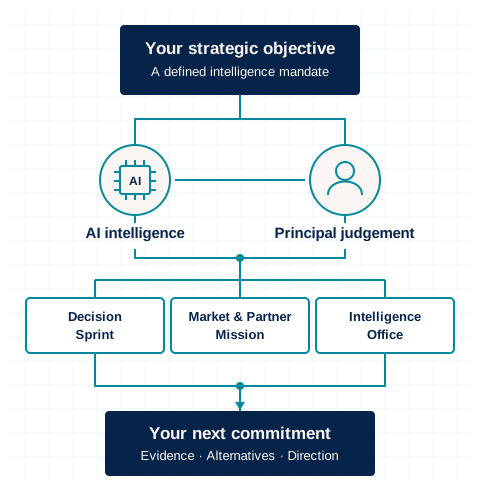
At Fractionova, this discipline is powered by agentic AI infrastructure and experienced technical-commercial judgement. Coordinated intelligence develops the commercial thesis, examines competing possibilities and reassesses the opportunity as its underlying conditions change.
The questions are consequential: What should we pursue? Where should we compete? With whom should we work? What would justify proceeding?
An opportunity can emerge before a market has a recognised category, an established procurement route or an obvious set of partners. Its early signals may be distributed across technical developments, investment decisions, customer requirements and changes in market access.
Fractionova’s intelligence infrastructure investigates the relationships between those signals. It connects an emerging requirement with a relevant capability, examines the conditions for deployment and identifies the commercial relationships needed to make the proposition viable.
The resulting commercial thesis explains who could value the offering, why the timing matters, how the business could reach the opportunity and what must be established before investment.
That thesis becomes the subject of further analysis. The engine examines supporting and contrary evidence, exposes dependencies and develops alternative paths. Technical-commercial judgement tests the evidence, examines uncertainty and guides the recommended direction.
Commercial potential depends on the interaction of several dimensions. Fractionova assesses them in relation to the client’s capabilities, objectives and constraints.
Where does a capability solve a commercially meaningful problem? What determines its readiness, integration requirements and relevance to a particular customer or operating environment?

Who experiences the need, who influences the specification and who commits the expenditure? Which procurement routes, channels and relationships provide credible access?

What determines the viability of the proposition? How do development costs, deployment obligations, commercial terms and investment requirements affect the case for proceeding?

Which organisations contribute capabilities, access or delivery capacity? Where could a partnership strengthen the proposition, and where might it constrain control or future choices?

How do tariffs, trade agreements, localisation priorities and geopolitical relationships affect the opportunity? What changes when a market prioritises domestic capability, supply resilience or strategic control?

What should happen first? Which commitments preserve flexibility, which create durable advantage and which expose the business before critical assumptions have been resolved?
Fractionova develops an assessment through six connected stages. Agentic investigation carries evidence and business context between them, while strategic direction and review keep the work aligned with the decision.
The engine investigates developments across technology, markets, capital, policy and geopolitical conditions. Analysis relates those signals to the client’s capabilities and priorities, identifying changes that warrant deeper examination.
The result: a defined commercial possibility and a reason to investigate it.
Agentic analysis connects the emerging requirement with a relevant capability, potential customers and plausible routes to market. It develops hypotheses about where value could be created and identifies the assumptions on which that value depends.
The result: an explicit proposition that can be tested against evidence.
Coordinated agents examine demand, technical fit, economics, counterparties and market-access conditions. Findings inform connected lines of enquiry, exposing dependencies, contradictions and alternative explanations.
The result: an evidence base that distinguishes supported conclusions from unresolved assumptions.
The engine compares strategic alternatives against the client’s objectives and constraints. The assessment tests commercial coherence, resource requirements and dependencies, with principal-led scrutiny of consequential trade-offs.
The result: a qualified view of the opportunity and the conditions required for it to succeed.
The assessment brings together the commercial thesis, alternatives, evidence and implications. Human leadership challenges the conclusions and guides a recommendation identifying what to pursue, test, sequence, defer or discontinue.
The result: a reasoned direction and defined next commitments.
Within the engagement’s monitoring scope, the engine connects new signals with the existing assessment. Changes can expand the opportunity space, narrow a route, alter priorities or trigger renewed investigation.
The result: an assessment that evolves with the conditions carrying the commercial case.
Fractionova’s agentic architecture coordinates AI models, large language models, specialist agents, research tools and retained business context around defined commercial objectives.
Model inference supports the examination of evidence, comparison of claims and development of analytical hypotheses. Coordinated agents investigate connected questions across markets, technologies and counterparties, exchanging findings so that developments in one area inform the others.
This enables the engine to examine combinations that deserve attention: a technology finding relevance in a different application, a policy change altering market accessibility, or a potential partner changing the economics of delivery.
The engine dynamically refines the opportunity space. Emerging evidence can expand the range of credible options, narrow a proposed route, change priorities or expose the need for a different commercial model. Retained context keeps that analysis connected to the client’s business as the engagement develops.
The intelligence therefore evolves with the decision. Configured monitoring and recurring analysis bring relevant changes back into the assessment, with coverage and review arrangements defined for the engagement.
A technology can remain technically compelling while the commercial conditions around it change materially.
A trade barrier may alter the economics of cross-border supply. A preferential agreement may improve access. An industrial-policy initiative may create demand for local production, technical collaboration or a different ownership structure.
Fractionova’s multidimensional intelligence radar integrates these developments into opportunity assessment. Agentic analysis evaluates their relevance to market selection, sourcing and deployment choices, partnership structures and investment sequencing.
The assessment considers both the opportunity under present conditions and the assumptions on which its continued attractiveness depends.
Geostrategic intelligence is part of the commercial reasoning that determines where, how and when to act.
Market research, business intelligence and competitive intelligence provide valuable perspectives. Their boundaries overlap, and an Opportunity Intelligence engagement can draw on all three.
Market research examines demand, customers and market conditions. Business intelligence interprets business and operational data. Competitive intelligence investigates rivals, positioning and competitive developments.
Fractionova connects relevant findings from these perspectives to a specific commercial thesis. The assessment asks whether the opportunity fits the business, which route offers the strongest position and what evidence supports the next commitment.
Its organising purpose is the qualification of a commercial direction. Market findings, counterparty information and analytical outputs acquire their value through their contribution to that decision.
These disciplines overlap. The comparison describes their typical emphasis and how Fractionova connects intelligence to a commercial direction.
| Approach | Principal question | Analytical emphasis | Typical output |
|---|---|---|---|
| B2B contact and supplier databases | Which organisations or contacts match our criteria? | Structured company, product and contact information | Records and lists for prospecting or further qualification |
| Market research | What characterises this market and its customers? | Demand, customer needs, segmentation and market conditions | Research findings and market assessments |
| Business intelligence | What does our business data reveal? | Performance, operational patterns and management information | Dashboards, reports and analytical findings |
| Competitive intelligence | How are competitors positioned, and what do their actions imply? | Competitor capabilities, strategies and market behaviour | Competitive assessments and implications |
| Fractionova Opportunity Intelligence | Which commercial direction should this business pursue, under what conditions and through which relationships? | Connected analysis of technology, demand, economics, counterparties and geostrategic conditions, evaluated against the client’s capabilities and objectives | A qualified commercial thesis, assessed alternatives, recommended direction and conditions for reassessment |
Fractionova’s contribution is the integration of these perspectives around a consequential decision. Its agentic infrastructure develops and tests the connections between evidence, while principal-led judgement challenges the conclusions and guides the recommendation.
Fractionova brings machine-driven analytical breadth, continuous intelligence infrastructure and principal-led commercial judgement into one engagement.
The engine investigates across connected dimensions, carries business context forward and incorporates changing signals into the assessment. The methodology structures that capability around the client’s strategic question, with explicit attention to evidence, dependencies and alternative explanations.
That commercial judgement is led by Fractionova’s founder, Prabha Shankar. His experience across engineering, international business development and motorsport management informs how consequential decisions are framed, assumptions challenged and commercial implications assessed.
The client receives a connected assessment of the opportunity, the position it could create and the commitments required to pursue it. The reasoning explains what supports the recommendation, which uncertainties matter and what would cause the direction to change.
The output is structured around the decision and can take the form of a focused assessment, a market and partner strategy or a continuing intelligence mandate.
A substantive assessment establishes:
This equips leadership to commit attention, engineering effort, relationships and capital with a clearer understanding of the opportunity and its consequences.
Both assessments are hypothetical illustrations of Fractionova’s approach, not client engagements or reported commercial results.
Where should a specialist automotive-performance business direct its next phase of development and commercial investment? Explore the choices between deepening its motorsport position, serving specialist vehicle manufacturers and developing a performance-aftermarket offering.
Which entry model gives a cooling-technology supplier a viable and defensible position in a new market? Explore how integration, service responsibilities, customer access and commercial control influence the decision.
Whether you are evaluating a technology application, entering a market or developing a strategic partnership, Fractionova brings coordinated intelligence to the conditions that determine its value.
Bring us the ambition, the decision and what is at stake.